
Three Strawberry Meditations
Three two-minute meditations that taught me to widen my awareness and stop treating every petty thought like truth.

“Why don’t I deserve a cup of tea?”
My mind starts calculating: the energy consumption, the wasted water that will further dehydrate me, the minutes spent on my selfish morning ritual.

A ghost whispers: “You are not worthy.”
When did this voice first take root?
I can’t remember.
But I remember when I was about 11 years old, stealthily standing outside my parents’ bedroom, listening to their raised voices. It terrified me. An insecure part of me needed to know: “Am I the reason you’re arguing?”
I learned to take up less space.
To be a shadow in rooms. To assume I was always the reason people that I love were hurting.
I tried to silence the voices. But they followed me into adulthood, whispering the same old stories in new life situations.
So I tried a simple experiment.

Three days. Three meditations like strawberries: tiny, but ripe with sensory bliss. Two minutes each.
STRAWBERRY MEDITATION #1:
What happens when we stay with our thoughts
I closed my eyes and counted from 1 to 100 in my head.
Immediately, my inner critic arrived: “This is silly. This is a stupid meditation. What am I even doing?”
But I kept counting. Counting past fifteen, something shifted. I heard the wind outside swirling, a blackbird chirping (probably plotting to steal my strawberries), and the rhythm of my own heart beating.
The nasty voice was still there. But it stopped being the only voice in the room.
Meditation teacher Joseph Goldstein calls this noticings per minute. The point isn't to silence thoughts—it's to widen your awareness. The more you notice, the less any single thought will dominate your attention.
Strawberry Meditation #1.
Set a timer for two minutes. Close your eyes and count slowly from 1 to 100. If you lose count, start again.
Don’t silence your thoughts. Just notice what thoughts arise. What petty or profound thoughts emerge? What sounds reach you? What sensations arise in your body?
STRAWBERRY MEDITATION #2:
When thoughts arrive with the weather
On a sunny day, I’m my finest self. I say: “kia ora” to every neighbour. I admire their greenhouses protecting little seedlings in the cold months, and feel the warmth in their voices when they wish me good health.
On a grey day, the same neighbourhood becomes hostile. People seem to judge me with scornful expressions for hesitating to cross the street. They can’t see I’m preoccupied with a medical treatment I can barely afford.
The only thing that changed between the two days was the weather—both outside and inside my mind.

We become the weather we're experiencing—what psychologist Richard Davidson (founder of Healthy Minds meditation app) calls experiential fusion. We lose the ability to see our thoughts as thoughts. We misread faces. We react before thinking clearly.
This mediation interrupted my weather pattern.
I didn’t need to wait for a sunny day to feel more expansive. I just needed to notice the stormy weather and remember I don’t have to become one with it.
Strawberry Meditation #2.
Set a timer for two minutes. Sit somewhere comfortable and ask yourself: What’s the weather pattern outside and inside my mind right now?
Don’t try to change it. Just describe it to yourself. Stormy? Gloomy? Sunny? Notice if the weather shifts at all as you watch it.
STRAWBERRY MEDITATION #3:
What thoughts are made of
Instead of resisting my negative thoughts, I invited this question: “What are my thoughts made of?”
Think of a strawberry.
What comes to mind? The radiant red colour, the tiny textured seeds? A memory of picking them as a child, or the taste of one perfectly ripe?
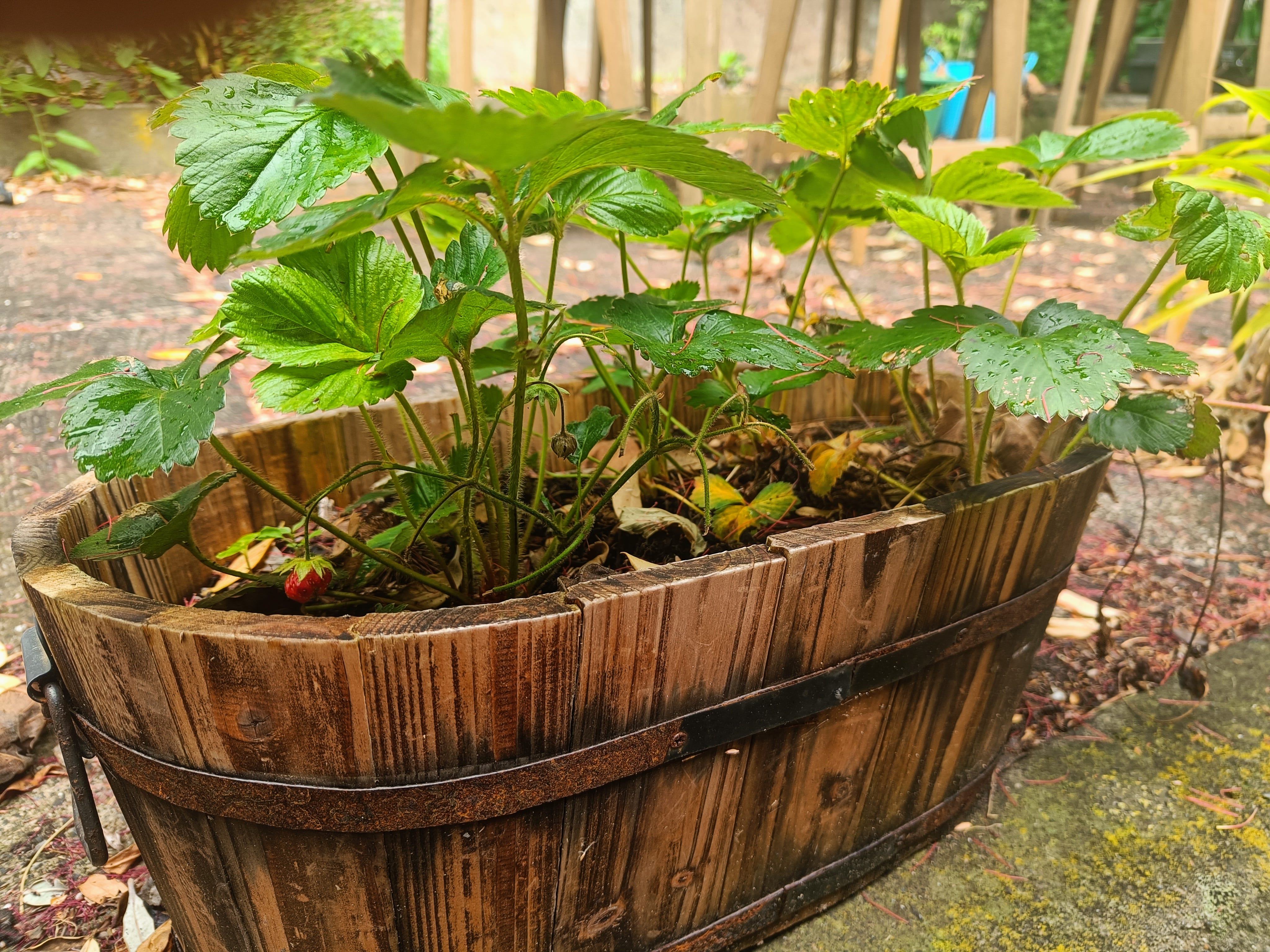
Now think of the word agenda.
What comes to mind? Powerpoint slides? A conference room? Do you feel intrigued, engaged or do you feel your energy drain?
This is the strange truth about thoughts: they follow attention like water taking the shape of its container. Point your mind somewhere, and thoughts rush to fill the space.
The trouble is, we often don’t choose where to point our attention. Negative automatic thoughts arise: “I’m not good enough, I’m being judged, I don’t deserve this.”
There’s a technique to step back called decentering. Imagine your thoughts as a river current that’s sweeping you downstream. Swimming against the current is exhausting. Decentering is about swimming sideways to the river bank and watching the water rush past from a different vantage point.
When the current changes, you’ll get swept away by your thoughts again. The practice is noticing when you’re being carried off course, and then swimming sideways to the shore.
Strawberry Meditation #3.
Set a timer for two minutes. Bring to mind something small that’s been bothering you—a worry, a frustration, an unresolved tension.
Now ask yourself: Is this thought a fact or an interpretation? What else is true right now? If I swam sideways from this current, what would I see from the riverbank?
Closing Notes.
The negative thought still visits. But after three days of practice, I noticed the thought without obeying it. I can hold it alongside other truths.
I didn't suddenly fix myself. I just stopped treating every thought like a final verdict. That child outside my parent's bedroom is still here. He still wonders if he is the reason, if he is too much, if he is not enough.
But now he has three strawberries.
One to notice more than the inner critic. One to witness the storm come in. One to observe from a different vantage point.
And now that's enough… I deserve my cuppa tea.
Nga mihi ki te hunga e whai ana i to rātou whainga… (Greetings to everyone who is pursuing their purpose)